



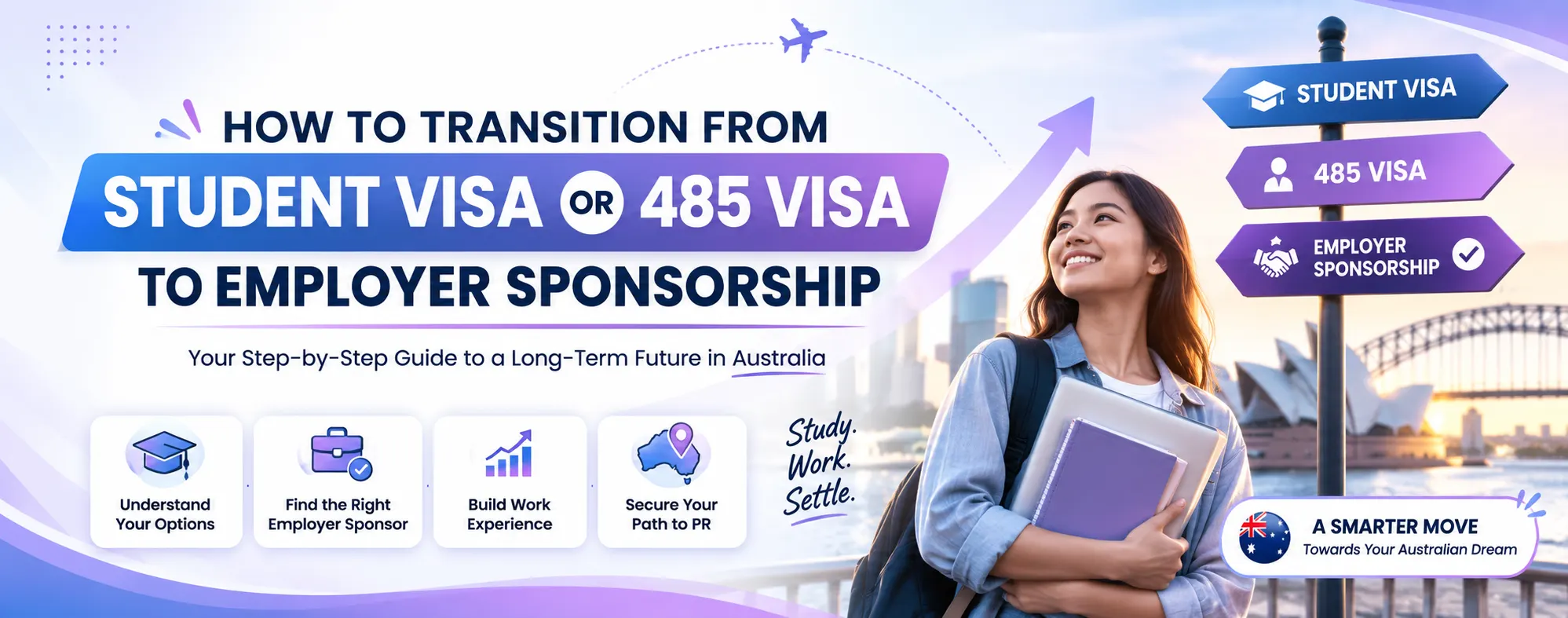
Looking to Move From a Student Visa or 485 Visa to Employer Sponsorship? Transitioning from a Student Visa (Subclass 500) or Temporary Graduate Visa (Subclass 485) to an employer-sponsored visa is one of the most effective pathways to building a long-term career and working towards permanent residency (PR) in Australia. However, with Australia’s evolving migration policies in 2026, planning ahead has become more important than ever.
Many international students wait until their 485 Visa is close to expiring before exploring sponsorship options. Unfortunately, this often results in missed opportunities, delayed Skills Assessments, or employment that doesn’t align with sponsorship requirements.
If you’re unsure which employer-sponsored visa suits your situation, seeking professional advice early can help you make informed decisions. Our experienced Student Visa Consultants and Registered Migration Agents in Melbourne assist international students in creating personalised migration strategies based on their qualifications, occupation, and long-term career goals.
Currently studying, graduated or even on a 485 Visa. This guide will help you in your transition to be successful in 2026, listing the necessary steps of what you need to do.
As visa requirements may change, it’s important to refer to the latest eligibility criteria published by the Department of Home Affairs before making migration decisions.
| Requirement | Details |
| Starting Visa | Student Visa (Subclass 500) or 485 Visa |
| Common Employer-Sponsored Visa | Subclass 482 |
| PR Pathway | Employer Nomination Scheme (Subclass 186) |
| Skills Assessment | Required for many occupations |
| English Requirement | Depends on visa and occupation |
| Best Time to Plan | During studies or early on your 485 Visa |
Why Planning Early Matters in 2026
By beginning your employer sponsorship process early, you have time to gain relevant experience and check important boxes needed to secure sponsorship. The focus of Australia’s migration strategy has shifted to skilled workers arriving to fill actual labour gaps. Instead of just treating the 485 Visa as extra time post-graduation, utilize it to ramp up your profile.
Focus on:
- Building relevant skilled work experience
- Completing your Skills Assessment
- Improving your English test score (if required)
- Securing employment in an eligible occupation
- Identifying employers who sponsor overseas workers
The sooner you start out with this process the more options you have before your actual visa runs out.
Need personalised advice? The best way to assess your potential eligibility and receive advice on the most appropriate employer-sponsored visa pathway for you is to arrange a consultation with our Melbourne migration team.
Can You Transition From a Student Visa to Employer Sponsorship?
Yes. With the correct pathway and current migration requirements, many international students with a Student Visa successfully transition into employer sponsorship. And the general flow of paths looks something like this:
Student Visa (Subclass 500)
⬇
Temporary Graduate Visa (Subclass 485)
⬇
Employer-Sponsored Visa (Subclass 482)
⬇Permanent Residency (Subclass 186)
Your eligibility depends on several factors, including:
- Your occupation
- Qualifications
- Skills Assessment
- English language proficiency
- Relevant work experience
- Employer sponsorship eligibility
However, as each applicant differs in their circumstances, obtaining professional migration advice can assist you in selecting the pathway that best suits your requirements.
Step 1: Choose an Occupation That Can Be Sponsored
Choosing an eligible occupation is probably one of the biggest considerations you will have due to its implications with your employer sponsorship and PR paths.
The biggest blunder graduates do is landing jobs not associated with their qualifications only for an income. Tourist or casual work is useful in terms of money, but it may nothelp to obtain your long-term migration.
Occupations commonly in demand include:
- Healthcare
- Nursing
- Information Technology
- Engineering
- Construction
- Trades
- Early Childhood Education
- Social Work
Check that your occupation is currently in demand. The first step before you take up a job, is to confirm if your occupation fulfills the criteria laid down by Australia.
Step 2: Complete Your Skills Assessment Early
A Skills Assessment prepares you and builds up your migration profile so that you’re in the best place to be when employer sponsorships starts becoming available. Most of the employer-sponsored and permanent residency pathways need a Skills Assessment from the appropriate assessing agency.
If you are in a profession right away, the assessment could take into account:- Australian qualifications
- Overseas qualifications
- Professional registration
- Employment history
- Practical experience
Since processing times can take a few months, you should do this as early as possible instead of waiting until your visa almost expires.
Stuck identifying the relevant assessing authority? If you are based in Melbourne, our RegisteredMigration Agents can identify the proper authority and assist you with the assessment procedure.
Step 3: Align Your Degree With the Correct ANZSCO Occupation
Selecting the right ANZSCO occupation will help you provide information on how your qualifications, work experience, and migration pathway meet the Australia visa requirements.
Here are a few common examples:
| Qualification | Possible ANZSCO Occupation |
| Bachelor of Nursing | Registered Nurse |
| Bachelor of Information Technology | Software Engineer / ICT Business Analyst |
| Bachelor of Early Childhood Education | Early Childhood Teacher |
| Bachelor of Civil Engineering | Civil Engineer |
| Bachelor of Social Work | Social Worker |
Selecting an occupation that doesn’t accurately reflect your qualifications or employment history may lead to unnecessary complications during your visa application.
Step 4: Find an Employer Who Can Sponsor You
Having a good professional reputation, often improves your opportunities for obtaining employer sponsorship, particularly in competitive sectors. The mistake that many graduates are making during their first interview is asking (spoiler) about sponsorship. Step one: dont, instead become an employee first.
Employers are generally more likely to sponsor candidates that consistently show:
- Strong performance
- Reliability
- Technical skills
- Professional attitude
- Long-term commitment
Demonstrating your worth before sponsorship can significantly increase the odds of success.
Understanding the Genuine Position Requirement
But first, an employer has to prove that the position is real, required for his/her business, and meets Australian migration laws before sponsoring an overseas worker. If an Australian employer sponsors a foreign employee, they must demonstrate that:
- The position is genuine and supports business operations.
- The role matches the nominated occupation.
- The salary meets current legislative requirements.
- Sponsorship complies with Australian migration laws.
Employers thus prefer candidates with local work experience and cues to day one contribution.
Employer-Sponsored Visa Options in 2026
Comparing Australia’s Employment Visa Options As You Align Your Skills With The Right Migration Pathway.
Temporary Skill Shortage Visa (Subclass 482)
Overview of Subclass 482 Visa in Australia The subclass 482 visa, also known as the Temporary Skill Shortage (TSS) visa, allows an Australian employer to sponsor a foreign worker on a temporary basis for a maximum period of four years.
Typical requirements include:
- Employer nomination
- An eligible skilled occupation
- Relevant qualifications and work experience
- English language proficiency
- Meeting salary and visa requirements
The 482 Visa is an essential pathway for many international graduates towards permanent residency.
Employer Nomination Scheme (Subclass 186)
The Subclass 186 Visa is a permanent residency visa for skilled workers sponsored by an employer.
Candidates need to present on the basis of the stream:
- Relevant qualifications
- Skilled work experience
- English language proficiency
- Skills Assessment (where applicable)
- Employer nomination
Eligibility requirements change based on visa stream and personalized but require professional advisement.
English Language and Work Experience Requirements
Your employer’s sponsored visa application, as well as your overall migration potential is enhanced by meeting English language and work experience standards. Most employer-sponsored visas require applicants to prove competent English by taking one of the following recognised tests:
- IELTS
- PTE Academic
- TOEFL iBT
- OET (for eligible health professionals)
Relevant professional work experience is critical too. The years of experience you need relies on a combination of your occupation, visa pathway and whether the Australian migration system has recognised that there is a shortage or not as well.
Understanding Employer Sponsorship Costs
It is essential that you know the costs involved so both Paying authorities and applicants can prepare manually for the sponsorship process without encountering any aggravating financial shocks.
Most of the government charges paid by the employers are as per:
- Sponsorship application fees
- Nomination fees
- Visa application charges
- Skilling Australians Fund (SAF) Levy
These costs passed on to the employee is something that cannot happen, practically speaking. We also encourage understanding the sponsorship process early to help with planning and openness for discussions with employers.
A Practical Timeline Before Your 485 Visa Expires
12 Months Before Expiry
- Confirm occupation eligibility
- Begin Skills Assessment
- Update your CV
- Improve English if required
9 Months Before Expiry
- Secure relevant skilled employment
- Discuss long-term career opportunities with your employer
6 Months Before Expiry
- Review sponsorship eligibility
- Prepare supporting documents
3 Months Before Expiry
- Lodge eligible visa applications
- Monitor processing
- Maintain lawful visa status
Considering Regional Sponsorship?
Regional Australia offers additional employer-sponsored opportunities for eligible graduates willing to live and work in designated regional areas. There maybe not enough sponsorship opportunities in metropolitan cities, therefore apply the Skilled Employer Sponsored Regional (Subclass 494) Visa.
Some industries are even still facing shortages throughout the years, and local employers find skill deficits in sectors like healthcare, construction, education, hospitality and engineering. Regional Sponsorship is a great route for many graduates towards permanent residency.
Why Choose Asia Pacific Group?
Having said that, the visa journey can be simplified with the assistance of experienced migration guys who will give you practical advice based on your education and occupation profile on what can be done if at all and what not to do in attaining long-term migration aspirations. Asia Pacific Group has been assisting international students and skilled migrants over 17 years successfully fulfil their aspiration of studying and settling in Australia.
Here are some areas that our expert team can help you in:
- Student Visa extensions
- Temporary Graduate (Subclass 485) Visa guidance
- Employer-Sponsored Visas
- Skills Assessments
- PR pathway planning
- Course selection aligned with migration goals
- Employer sponsorship strategies
Employer Sponsorship Checklist
Before you start your employer sponsorship journey, ensure that;
- Confirm your occupation is eligible.
- Start or complete your Skills Assessment.
- Gain relevant skilled work experience.
- Meet English language requirements.
- Prepare your employment and education documents.
- Identify potential sponsoring employers.
- Seek professional migration advice before lodging your application.
Ready to Plan Your Employer Sponsorship Journey?
Migration begins with smart choices. Getting organised in advance makes your switch to employer sponsorship from a Student Visa far easier and less daunting.
Whether you are on studying in Melbourne, are currently holding a 485 Graduate Visa, or preparing for permanent residency, our Registered Migration Agents and professional Student Visa Consultants in Melbourne have got your back to explore each one so you can plan your next move through all the stages of the process.
Schedule your personal consultation with Asia Pacific Group now for assistance and expert advice on your Employer Sponsored Visas, Skills Assessments and Permanent Residency in Australia.


