



Want your mum or dad to live with you in Australia for good? The parent visa subclass 103 is one way to make that happen.
It is a permanent visa. But the wait is long, and the rules are strict. This guide explains the parent visa subclass 103 in plain words, so you know what to expect before you apply.
Table of Contents
- What Is the Parent Visa Subclass 103?
- Parent Visa Subclass 103 at a Glance
- Who Can Apply for Parent Visa Subclass 103?
- Parent Visa Subclass 103 Cost
- Benefits of Parent Visa Subclass 103
- Parent Visa Subclass 103 Processing Time
- How to Apply for Parent Visa Subclass 103
- Including Family in Parent Visa Subclass 103
- Where You Can Apply for Parent Visa Subclass 103
- Travel Rules for Parent Visa Subclass 103 Holders
- Parent Visa Subclass 103 vs Other Parent Visas
- Your Duties After Parent Visa Subclass 103 Grant
- Parent Visa Subclass 103 FAQs
- Conclusion: Get Help From a Migration Agent Australia
What Is the Parent Visa Subclass 103?
The parent visa subclass 103 lets a parent move to Australia permanently. Your child must be a settled Australian citizen, a permanent resident, or an eligible New Zealand citizen.
It is also called the Parent visa. It is often the cheapest permanent visa for parents. The trade-off is time. Many people wait for years.
Parent Visa Subclass 103 Online Lodgement
Parent visa subclasses 103, 143, 804 and 864 must now be lodged online through ImmiAccount. Paper forms are no longer used for these visas.
Parent Visa Subclass 103 at a Glance
| Stay Permanent |
Cost From AUD 8,665 (2 instalments) |
Travel 5 years of free travel |
Who Can Apply for Parent Visa Subclass 103?
You must meet these basic rules:
- You have a child who is a settled Australian citizen, permanent resident or eligible New Zealand citizen.
- You follow all visa conditions and Australian law.
- You have not already applied for, or hold, a Sponsored Parent (Temporary) visa subclass 870 when you apply.
Balance of Family Test for Parent Visa Subclass 103
Most applicants must pass the balance of family test. In simple terms, at least half of your children must live permanently in Australia. Or, more of your children must live in Australia than in any other single country.
Sponsor and Assurance of Support for Parent Visa Subclass 103
Most applicants also need a sponsor and an Assurance of Support. This is a promise that someone will repay certain welfare payments if you need them.
Retirement Pathway for Parent Visa Subclass 103
You can apply under the Retirement visa pathway. If you do, you do not need to meet the balance of family test. You also do not need a sponsor or an Assurance of Support.
Parent Visa Subclass 103 Cost
The visa costs from AUD 8,665 for one applicant. Each family member who applies with you costs extra.
You pay in two instalments. The first is paid when you apply. The second is paid when the Department asks for it.
How You Pay for Parent Visa Subclass 103
Total from AUD 8,665 for a single applicant.
Other Costs for Parent Visa Subclass 103
Plan for more than the visa charge. You may also pay for health checks, police certificates and biometrics for each applicant.
Lower Cost for Pacific Island and Timor-Leste Citizens
From 1 July 2026, a lower visa cost applies to eligible citizens of some countries. Your passport must be from one of these:
Federated States of Micronesia, Fiji, Kiribati, Nauru, Palau, Papua New Guinea, Republic of the Marshall Islands, Samoa, Solomon Islands, Timor-Leste, Tonga, Tuvalu and Vanuatu.
Family members get the lower cost too. It is based on the main applicant’s passport.
Always check the current visa pricing on the Home Affairs website before you pay.
Benefits of Parent Visa Subclass 103
With this visa, you can:
- Stay in Australia indefinitely
- Work and study
- Enrol in Medicare, Australia’s public health scheme
- Sponsor your own family members to come to Australia
- Travel to and from Australia for 5 years
- Join free English classes under the Adult Migrant English Program, if eligible
- Apply for Australian citizenship, if eligible
Parent Visa Subclass 103 Processing Time
More people want this visa than there are places each year. So the waiting time is long.
Applications are capped and queued. They are handled in the order they arrive. For the latest wait, check the Parent visa queue release dates on the Home Affairs website.
2 Stages of Parent Visa Subclass 103 Assessment
- The Department checks if you are eligible. Then it adds you to the queue or refuses the application.
- When a place opens, your application is released from the queue for the final check.
Do not make plans to live in Australia permanently until the visa is granted. You will be told in writing.
What Can Slow Down Parent Visa Subclass 103?
- The form is not filled in correctly
- Documents are missing, or more information is needed
- Your information takes a long time to check
- The correct visa charge was not paid
How to Apply for Parent Visa Subclass 103
The process has seven simple steps.
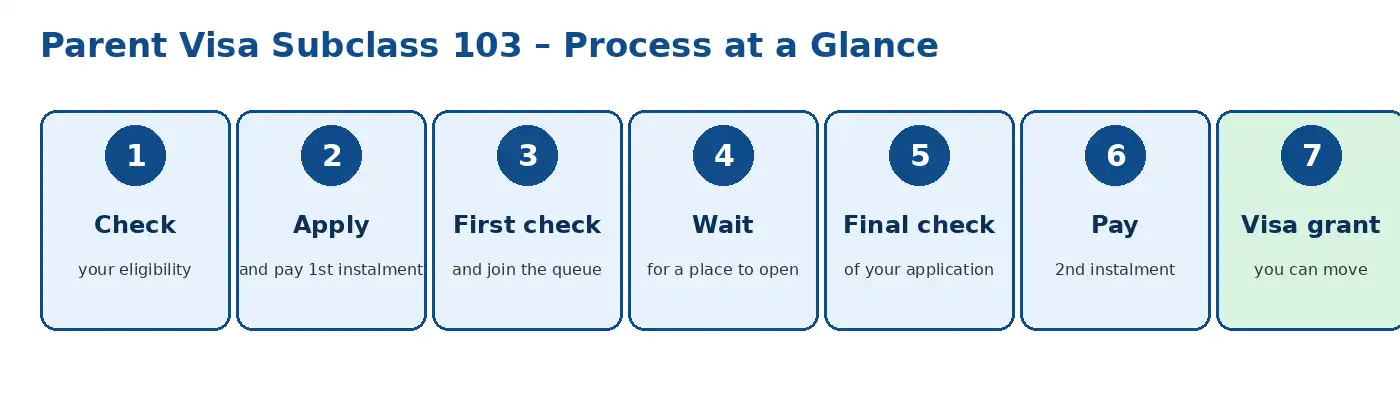
Step-by-Step Parent Visa Subclass 103 Application
Including Family in Parent Visa Subclass 103
You can add family members to your application. You must list all your family members on the form, even those who are not migrating.
Family members who apply must meet health and character requirements. Those who are not coming might need to meet them too.
Retirement Pathway and Family Members
Under the Retirement pathway, you can include your partner only if they also hold a Retirement or Investor Retirement visa. You cannot include your children.
Newborn Baby During Your Parent Visa Subclass 103 Application
If you have a baby while your application is open, you need to tell the Department. Check the “had a child” page on the Home Affairs website for the steps.
Where You Can Apply for Parent Visa Subclass 103
You and your family can apply from inside or outside Australia. But you cannot be in immigration clearance when you apply.
Retirees must be in Australia (not in immigration clearance) at the time of applying. They can be in or outside Australia when the decision is made.
Travel Rules for Parent Visa Subclass 103 Holders
You can travel in and out of Australia as often as you like for 5 years from the grant date. After that, you have two options:
- Apply for a Resident Return visa (RRV) to come back as a permanent resident.
- Apply for Australian citizenship. Citizens do not need a visa, but they do need an Australian passport.
You can check your travel facility end date on VEVO.
When Does Permanent Residence Start for Citizenship?
Your permanent residence starts on the day the visa is granted, if you are in Australia. If you are outside Australia, it starts the day you enter on this visa.
Parent Visa Subclass 103 vs Other Parent Visas
Waiting too long? Other options may be faster, but they usually cost more.
| Visa | Type | Key point |
|---|---|---|
| Parent visa (103) | Permanent | Lower cost, long queue |
| Contributory Parent (143) | Permanent | May be faster, costs more |
| Contributory Parent (Temporary) (173), then 143 | Temporary, then permanent | Faster, but costs more than 103; cost is spread over 2 visas |
| Sponsored Parent (Temporary) (870) | Temporary | Stay 3 or 5 years at a time, up to 10 years in total |
Your Duties After Parent Visa Subclass 103 Grant
- Enter Australia before the date in your grant letter.
- Follow all visa conditions, you and your family.
- Obey Australian laws.
You will not get a label in your passport. The visa is linked to your passport digitally.
Parent Visa Subclass 103 FAQs
Is the parent visa subclass 103 permanent?
Yes. You can stay in Australia indefinitely.
How much does parent visa subclass 103 cost?
It costs from AUD 8,665 for one applicant, paid in 2 instalments. Family members cost extra.
How long does parent visa subclass 103 take?
There is no fixed time. Applications join a queue and are processed in order. Check the queue release dates for the latest update.
Can I work on parent visa subclass 103?
Yes. You can work and study in Australia.
Can I get Medicare on parent visa subclass 103?
Yes. Holders can enrol in Medicare.
Can I apply for parent visa subclass 103 from outside Australia?
Yes. You can apply from inside or outside Australia, but not while in immigration clearance.
Can I apply for Australian citizenship on parent visa subclass 103?
Yes, if you meet the citizenship rules.
Conclusion: Why Choose a Migration Agent Australia for Parent Visa Subclass 103
The parent visa subclass 103 gives your parents a permanent home in Australia at a lower cost than other parent visas. The price you pay is time, because the queue is long.
A small mistake can cost you months. That is why many families work with a registered migration agent Australia wide. A good agent checks your eligibility, prepares your documents and files your application correctly the first time.
Not sure whether subclass 103 or a faster visa is right for your parents? Speak to a trusted migration agent Australia families rely on, and get clear advice for your situation.
Ready to Start Your Parent Visa Subclass 103 Application?
Book a consultation with a MARA-registered migration agent today.
Important: This article provides general information only. Visa requirements, charges and processing times change, and your eligibility depends on your individual circumstances. Always check the latest information on the official Department of Home Affairs website before you make a visa application. For advice about your situation, consider speaking with a registered migration agent or qualified legal professional.


