




A trade qualification can be an important step towards building a career in Australia. However, holding a trade certificate does not automatically make someone eligible for permanent residency (PR). Your occupation, skills assessment, employment history and the requirements of your chosen visa pathway all need to be considered.
For tradespeople living or working in Thomastown and other Melbourne suburbs, understanding how their current trade experience connects with Australia’s skilled migration system is an important starting point.
The assessment requirements and visa options may differ for a mechanic, electrician, carpenter, plumber or cabinetmaker. The right pathway depends on more than the name of your qualification.
Here are the key points to consider before moving from a trade qualification towards Australian PR.
IN THIS GUIDE
- Can a Trade Qualification Lead to Australian PR?
- Check Your Occupation Before Choosing a Visa
- Understand Your Trade Skills Assessment
- Which TRA Assessment Program May Apply?
- What Documents Should You Prepare?
- Explore the Main PR Pathways for Trade Workers
- Does Living in Thomastown Affect Your PR Options?
- Common Mistakes Trade Workers Should Avoid
- How APG Can Help
Can a Trade Qualification Lead to Australian PR?
Yes. Certain trade qualifications and relevant work experience can support an Australian permanent visa application. However, eligibility depends on the nominated occupation and the visa pathway being considered.
A trade qualification can help demonstrate your knowledge and training in an occupation. Depending on the visa, you may also need employment history, a suitable skills assessment, English proficiency and to meet applicable age and points requirements.
For example, someone with a certificate in automotive technology may not necessarily satisfy the requirements for the nominated Motor Mechanic occupation. The assessing authority may need to review the qualification, training content, workplace duties and supporting evidence.
From Trade Qualification to PR: Four Important Checks
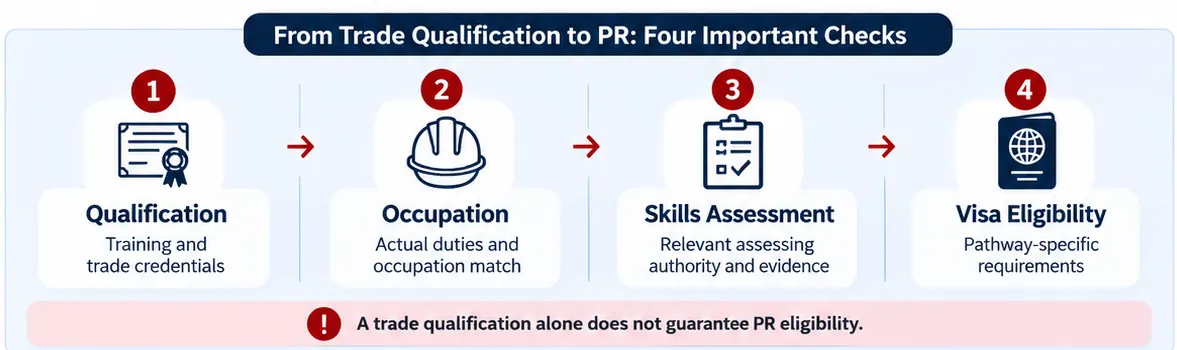
| Step | What to Check |
|---|---|
| 01. Qualification | Trade certificate, training and credentials |
| 02. Occupation | Actual job duties and occupation match |
| 03. Skills Assessment | Relevant assessing authority and evidence |
| 04. Visa Eligibility | Requirements of the selected visa pathway |
Remember: A trade qualification alone does not guarantee PR eligibility.
Check Your Occupation Before Choosing a Visa
Before spending money on a skills assessment, identify the occupation that best describes the work you actually perform.
Occupational classification describes the skills and tasks associated with occupations in Australia. This includes the use of ANZSCO codes. The skilled occupation list requirements can also differ between visa programs.
Why Your Job Title Is Not Enough
Your employment contract may describe you as a technician, trades assistant, workshop worker or maintenance worker. However, your nominated occupation must be supported by your actual duties and the relevant occupation description.
Consider these points before choosing an occupation:
- Daily responsibilities: Do your tasks match the occupation’s description?
- Qualifications: Is your trade qualification relevant to the occupation?
- Employment history: Can you demonstrate the required experience?
- Occupation list: Is the occupation available for the visa subclass you are considering?
- Assessing authority: Which organisation is responsible for assessing your occupation?
- Licensing: Does your trade require registration or a licence in Victoria?
You can check the relevant occupation and assessing authority through the Department of Home Affairs’ skilled occupation list.
Understand Your Trade Skills Assessment
A skills assessment examines your qualifications, training and work experience in relation to the skills required for your nominated occupation. It is a separate process from applying for a visa.
Trades Recognition Australia (TRA) is one of the organisations responsible for trade skills assessments in Australia. However, not all trade occupations are assessed by TRA. Check the appropriate authority for your occupation before applying.
Which TRA Assessment Program May Apply?
TRA offers different assessment programs. The appropriate program depends on your circumstances, including your country of qualification, occupation, passport country and visa purpose.
| Assessment Program | General Purpose |
|---|---|
| Job Ready Program (JRP) | For eligible international graduates in Australia with a relevant Australian trade qualification. |
| Offshore Skills Assessment Program (OSAP) | For specified occupations and passport countries, including certain licensed trades. |
| Migration Skills Assessment (MSA) | For eligible trade workers seeking permanent skilled migration where this program applies. |
| TSS Skills Assessment | For specified applicants seeking the relevant employer-sponsored temporary visa assessment. |
TRA Assessment Programs at a Glance
JRP
Job Ready Program
For eligible international graduates with relevant Australian trade qualifications.OSAP
Offshore Skills Assessment Program
For specified occupations and eligible applicants.MSA
Migration Skills Assessment
For eligible trade workers where this assessment program applies.TSS
TSS Skills Assessment
For specified applicants seeking relevant employer-sponsored assessment.Note: These programs are not interchangeable. Check the current TRA program guidelines and Pathfinder tool before applying.
For example, TRA recognises certain occupations, including General Electricians, Special Class Electricians, General Plumbers and Air-conditioning and Refrigeration Mechanics, for permanent migration assessment through the Offshore Skills Assessment Program.
The Migration Skills Assessment program also has its own eligibility requirements. It is not suitable for every trade worker or visa purpose. Review the relevant program guidelines and the TRA website before selecting an assessment route.
What Documents Should You Prepare?
Your evidence should clearly connect your qualifications, training and employment history to your nominated occupation.
Depending on the assessment program, the following documents may be useful:
Trade Skills Assessment Document Checklist
- Passport identification page.
- Trade certificates and qualification documents.
- Academic transcripts showing subjects and training completed.
- Apprenticeship contracts, training records or logbooks, if applicable.
- Employer statements describing your duties and employment periods.
- Payslips and other acceptable evidence of paid employment.
- Tax records or business documents where relevant to self-employment.
- Registration or licensing documents, if applicable.
A resume or employment letter that only mentions your job title may not provide enough detail. Assessing authorities may request supporting evidence to verify your work duties and employment periods.
TRA also clarifies that relevant formal qualifications cannot be substituted by work experience alone for the Migration Skills Assessment Program. If you do not hold a suitable qualification, consider whether an appropriate Recognition of Prior Learning (RPL) process with an Australian Registered Training Organisation (RTO) may be relevant.
Explore the Main PR Pathways for Trade Workers
Once you understand your occupation and assessment requirements, you can compare the visa options that may be relevant to your circumstances. There is no single PR visa pathway that applies to every tradesperson.
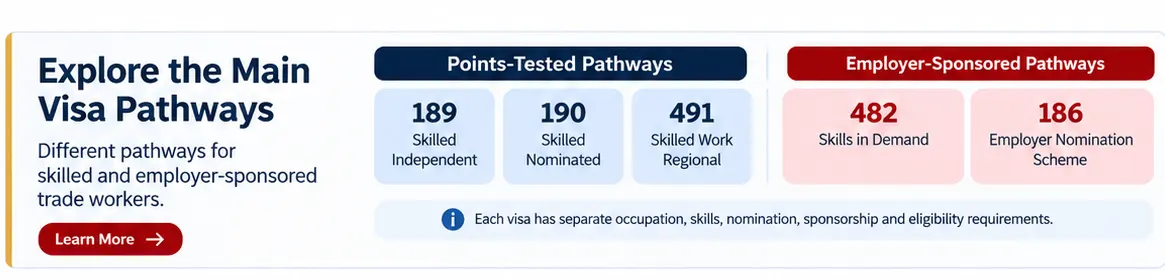
Points-Tested Visas: 189, 190 and 491
These visas use a points-tested invitation system. Applicants generally need a suitable skills assessment, an eligible occupation, the required English level and at least 65 points to be eligible to submit an Expression of Interest (EOI).
| Visa | General Pathway |
|---|---|
| Subclass 189 | Skilled Independent visa. Does not require state nomination or employer sponsorship. |
| Subclass 190 | Skilled Nominated visa. Requires nomination by an Australian state or territory. |
| Subclass 491 | Skilled Work Regional (Provisional) visa. Requires state or territory nomination or eligible family sponsorship, with regional living and working arrangements. |
For Victorian applicants, state nomination has its own process. As of 2 November 2026, Victoria’s 2026–27 program has 900 places for subclass 190. Its subclass 491 allocation has not yet been finalised, and Registrations of Interest for that pathway are not currently being accepted.
Employer-Sponsored Visas: 482 and 186
If you have an Australian employer who is willing and able to sponsor you for a skilled occupation, employer sponsorship may be worth exploring.
Subclass 482 – Skills in Demand Visa
The Skills in Demand visa (subclass 482) is a temporary employer-sponsored visa. The Core Skills stream generally requires at least one year of relevant work experience, an eligible nominated occupation, a suitable sponsor and a salary that meets applicable requirements. A skills assessment may also be required in some circumstances.
Subclass 186 – Employer Nomination Scheme
The Employer Nomination Scheme visa (subclass 186) is a permanent employer-sponsored visa. The Direct Entry stream generally requires at least three years of relevant work experience and a positive skills assessment unless an exemption applies. Occupation, age, English, nomination and licensing requirements must also be considered.
Although employer sponsorship may provide a pathway to permanent residency for eligible applicants, a transition is not automatic. The requirements of each applicable subclass 186 stream must be assessed separately.
Compare the Main Visa Pathways
Explore the key differences between popular skilled and employer-sponsored visa options in Australia.
Skilled Independent
A points-tested pathway without requiring state or territory nomination or employer sponsorship.
Skilled Nominated
A points-tested pathway that requires nomination from an Australian state or territory.
Skilled Work Regional
A provisional regional pathway requiring state or territory nomination, or eligible family sponsorship.
Skills in Demand
A temporary employer-sponsored visa for eligible skilled workers nominated by an approved employer.
Employer Nomination Scheme
A permanent employer-sponsored visa pathway for eligible skilled workers nominated by an Australian employer.
Important to Remember
Each visa has separate occupation, skills assessment, nomination, sponsorship and eligibility requirements. Meeting the requirements for one pathway does not automatically make you eligible for another.
Does Living in Thomastown Affect Your PR Options?
Location can be an important factor, particularly when considering regional migration pathways.
Thomastown and Regional Migration
Thomastown is part of metropolitan Melbourne.
It is not included in the designated regional postcode areas listed by the Department of Home Affairs.
This matters because some visa pathways have regional nomination, sponsorship, residence or employment conditions. These include pathways such as subclass 491 and subclass 494.
A regional visa is not granted simply because someone lives or works in Thomastown. Before making a decision, confirm the postcode of the workplace and the location requirements of the visa. Not every Victorian location is considered regional.
Some workers may find subclass 189, subclass 190 or an employer-sponsored pathway more relevant. The appropriate option depends on the occupation, applicant profile and current program criteria.
Common Mistakes Trade Workers Should Avoid
A strong trade background can be helpful, but certain mistakes may create difficulties during the assessment or visa process.
- Choosing an occupation based only on the job title: Your actual tasks and skills must be consistent with the nominated occupation.
- Assuming every trade uses TRA: The assessing authority and assessment program depend on the occupation and visa.
- Submitting incomplete employment evidence: Keep payslips, employer statements, contracts and other supporting documents organised.
- Confusing a skills assessment with PR eligibility: A positive assessment does not automatically provide a visa invitation or grant.
- Ignoring licensing requirements: Some trades have separate Victorian registration or licensing rules.
- Assuming 65 points guarantees an invitation: Meeting the minimum points threshold does not guarantee an invitation.
- Treating Thomastown as a regional location: Thomastown is part of metropolitan Melbourne, so check the designated postcode requirements before considering a regional pathway.
How APG Can Help
Applying for Australian PR with a trade qualification involves more than choosing a visa subclass. You need to understand whether your occupation is appropriate, which assessment authority applies and whether your work experience meets the relevant migration requirements.
At APG, our expert immigration agents in Thomastown provides guidance on skilled migration, work visa and permanent visa pathways. APG’s services include skilled migration consultations and skills assessment guidance to help you understand the requirements relevant to your circumstances.
If you are unsure how your trade qualification and employment history fit into Australia’s migration framework, a preliminary discussion can help you understand the next steps before making decisions.
Explore APG’s skills assessment services and general skilled migration services to learn more.
Important Information
This article provides general information only and should not be considered immigration or legal advice. Visa criteria, occupation lists, skills assessment requirements and state nomination settings can change. Individual eligibility depends on the applicant’s circumstances and the requirements in force at the time of application. Seek advice from a Registered Migration Agent before making an immigration decision.


