



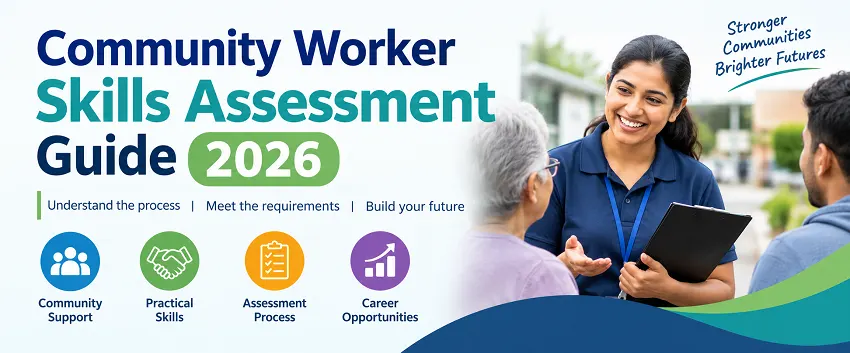
If you trained overseas and want to work as a community worker in Australia, one document decides almost everything that follows: your skills assessment outcome. This guide breaks down exactly what it involves, who needs it, and how to get it right the first time.
In This Guide
- What Is a Community Worker Skills Assessment
- Who Needs a Community Worker Assessment
- Occupations This Skills Assessment Covers
- Community Worker Skills Assessment Criteria
- Qualification Requirement Explained
- English Language Requirement
- Work Experience Requirement
- Skills Assessment Document Checklist
- How to Apply for the Assessment
- Skills Assessment Fees and Timelines
- Why Skills Assessments Get Rejected
- What Happens After You Submit
- Review and Appeal Rights
- Tips for a Strong Skills Assessment
- Final Thoughts
What Is a Community Worker Skills Assessment
A community worker skills assessment is an independent check of your qualifications, English ability, and hands-on experience against the standard expected of someone doing that job in Australia. It is not a test you sit in a room. It is a paper-based review carried out by an authorised body that compares your background line by line against a fixed set of criteria.
The organisation currently responsible for this review is Community Work Australia, previously known as ACWA (Australian Community Workers Association). The rename took effect in August 2025, but the assessment framework itself has not changed. You will still see both names used across older guides and forums, so do not be confused if a source refers to “ACWA” — it is the same authority.
For skilled migration, this outcome is not optional. Without a positive result, you cannot lodge an Expression of Interest through SkillSelect for the occupations this authority covers.
Who Needs a Community Worker Assessment
You need this assessment if you plan to apply for an Australian skilled visa and your nominated occupation falls under community services. This typically includes people applying through:
- Skilled Independent visa (subclass 189)
- Skilled Nominated visa (subclass 190)
- Skilled Work Regional visa (subclass 491)
- Designated Area Migration Agreement (DAMA) occupations
- Aged Care Industry Labour Agreement (ACILA) pathways
If you already hold a related qualification but trained outside Australia, this step confirms that your training and work history genuinely match what an Australian employer would expect from someone in that role.
Occupations This Skills Assessment Covers
Community Work Australia does not assess every welfare-related job title. It covers a defined list of occupations under the ANZSCO classification system, including:
- Community Worker
- Welfare Worker
- Family Support Worker
- Youth Worker
- Disabilities Services Officer
- Residential Care Officer
- Aged or Disabled Carer (under ACILA)
- Selected occupations under DAMA regional agreements, such as Community Corrections Worker, Outreach Worker, and Case Worker
Social Worker is assessed separately by the Australian Association of Social Workers (AASW), not by Community Work Australia. If your title includes “social worker,” check the correct authority before applying.
Community Worker Skills Assessment Criteria
Every application, no matter the occupation, is measured against the same three pillars. Meeting one strongly does not compensate for falling short on another — each is assessed on its own.
| Criterion | What It Checks |
|---|---|
| Qualification | Whether your study is equivalent to an Australian qualification at the required level |
| English proficiency | Whether your language ability meets the threshold set for the occupation |
| Industry experience and currency | Whether your paid work history is recent, relevant, and sufficient in duration |
Qualification Requirement Explained
Most occupations under this pathway require a qualification at Australian Qualifications Framework (AQF) Level 5 or above — broadly, a diploma or higher in a field such as community services, welfare, youth work, disability support, or a closely related discipline.
Your course content matters more than the certificate title. Assessors compare your subjects, practicum hours, and course duration against the Australian benchmark for that occupation. A diploma with thin practical content may need to be paired with extra industry experience to close the gap.
English Language Requirement
English proficiency is assessed as a standalone criterion for these occupations. Depending on your visa pathway, you may need to provide an approved English test result — such as IELTS, PTE, or an equivalent — that meets the score threshold set for your nominated occupation and visa subclass.
If you completed your entire qualification in English at a recognised institution, some applicants may be able to rely on that instead of a separate test, though this is assessed case by case and should never be assumed without checking first.
Work Experience Requirement
Experience is judged on two things: relevance and currency. Relevance means your duties closely match the tasks listed in the ANZSCO description for your nominated occupation — not just a similar-sounding job title. Currency means the work needs to be reasonably recent, not a role you held a decade ago with nothing since.
Paid, supervised, and properly documented employment carries the most weight. Volunteer work and unpaid placements can sometimes support an application, but they rarely substitute for the core paid-experience requirement on their own.
Skills Assessment Document Checklist
A decision-ready application moves faster and avoids unnecessary back-and-forth. At a minimum, expect to gather:
- Certified copies of academic transcripts and testamurs
- Detailed course syllabus or subject descriptions, if requested
- Passport identification pages
- Employment reference letters stating duties, hours, dates, and salary
- Payslips, tax records, or superannuation statements supporting your work history
- English test results, where applicable
- Certified translations for any document not originally in English
Getting Non-English Documents Translated
Translation tip: Non-English documents generally need a certified translation alongside the original. Translators accredited at NAATI Level 3 are usually the safest choice, since assessors can request this level of accreditation specifically.How to Apply for the Assessment
The application itself runs entirely online through the assessing authority’s portal. Broadly, it follows this sequence:
- Check your occupation: Confirm your intended job title is on the assessable list and read its specific criteria closely.
- Self-assess honestly: Compare your qualification, English result, and work history against the published benchmark before you spend money on the application.
- Create a portal account: Migration agents use a separate login and submit a signed authorisation form on the client’s behalf.
- Complete the online form: Enter your personal, education, and employment details accurately and consistently with your supporting documents.
- Upload documents and pay: Submit clear, complete scans and pay the assessment fee to move your file into the processing queue.
- Wait for the outcome: You will be notified by email once a decision has been made.
Skills Assessment Fees and Timelines
Fees vary depending on which stream applies to your occupation and visa pathway, and they are generally non-refundable once assessment work has begun. Processing currently runs around 10 to 12 weeks from the date of a complete, paid submission, though incomplete files or referee delays can push this out further.
There is no paid fast-track option, so the single biggest lever you control is submitting a genuinely complete application the first time.
Why Skills Assessments Get Rejected
Most unsuccessful outcomes trace back to a handful of avoidable issues rather than a lack of genuine skill:
- Nominating an occupation that does not match actual day-to-day duties
- Reference letters that are vague about hours, dates, or responsibilities
- Course content that falls short of the required AQF level in practice, even with the right certificate title
- Work history with gaps that are not explained or evidenced
- Uncertified copies or missing translations
What Happens After You Submit
Once your file is marked as received, it moves through document verification before being assessed against the three criteria. If anything is unclear, the assessing team may contact you or your listed referees directly, which can extend the timeframe. A final written outcome is then issued by email, confirming whether the result is positive or unsuccessful.
Review and Appeal Rights
An unsuccessful outcome is not always the end of the road. Applicants generally have the right to request a formal review of the decision, and if that review is also unfavourable, a further appeal option may be available. Both processes have their own timeframes and evidence requirements, so it is worth acting quickly rather than letting the window close.
Tips for a Strong Skills Assessment
- Match your reference letters word-for-word to the duties listed for your nominated occupation, not a generic job description.
- Get certified translations done early — this step often causes the longest delays.
- Keep a running file of payslips and tax documents rather than trying to locate them all at the last minute.
- Choose the occupation your actual experience supports, even if a different title looks more appealing on paper.
- Consider a qualified migration agent if your work history spans multiple countries or unconventional job titles — an outside eye often catches gaps you cannot see yourself.
Final Thoughts
A community worker skills assessment is ultimately a matching exercise: your paperwork against a fixed benchmark. Applicants who take time to understand exactly what that benchmark looks like, and who build their file around it deliberately, tend to move through the process with far fewer surprises. Treat the preparation stage as seriously as the visa application itself, because for this occupation group, it is the gateway everything else depends on.


