Get Free Education Consultation at Our Office. Book Your Appointment Today!
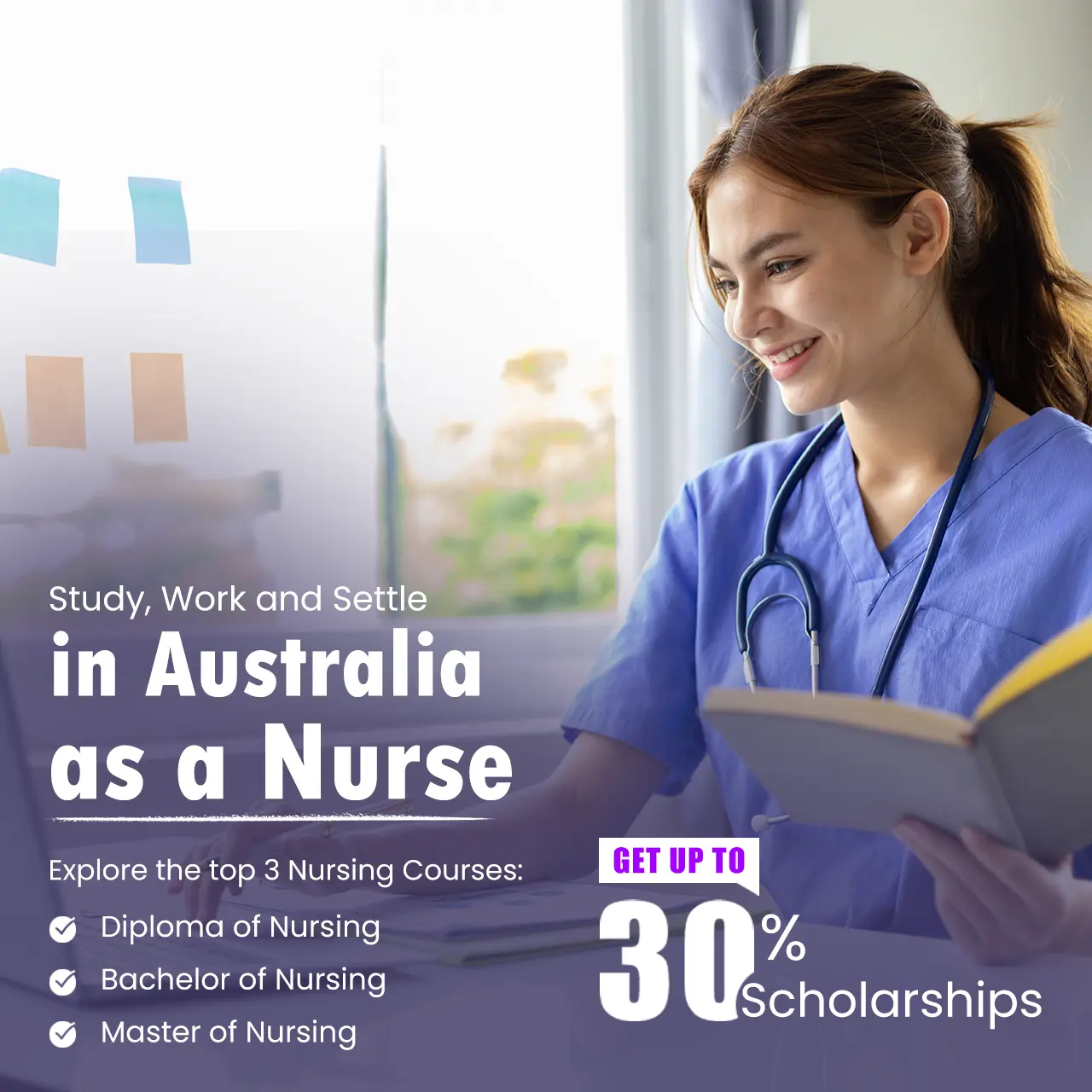
Nursing-DEC-bannner image
Talk to Our Expert Education Counselors

Nursing Courses in Australia

Australia offers multiple pathways depending on where you are in your nursing career.

Diploma of Nursing

This is an entry-level nursing pathway to become an Enrolled Nurse (EN). It is an 18-24 months long, full-time course.

Pursue a diploma of nursing from TAFE or private Registered Training Organisations (RTOs). After the course, you register with AHPRA (Australian Health Practitioner Regulation Agency) and practice as Enrolled Nurse (EN).

As an EN, you work under Registered Nurses (RNs). You can use this as a stepping stone to become an RN by doing a Bachelor of Nursing.

Entry Requirements:
  • Year 12 (or equivalent)
  • English language competency (IELTS or equivalent, especially for international students)
  • Police check, immunisations, Working with Children Check
Scope of Practice:
  • Administer medications (given you have ‘medication endorsement’)
  • Monitor vital signs and report changes
  • Provide wound care
  • Assist with routine activities — feeding, mobility, hygiene
  • Assist in aged care, hospitals, clinics, or community health

Bachelor of Nursing

This is an advanced nursing pathway that offers more autonomy to you as a Registered Nurse (RN). It is a 3-year full-time program, but some universities offer it for 2 years, given that you already have an EN Diploma.

After graduating, you register with AHPRA as a Registered Nurse. RNs have broader and more complex roles, like midwifery, Mental Health, Critical Care, Emergency, or leadership roles like Clinical Nurse Specialist, Nurse Unit Manager, Director of Nursing, etc. You can also do a Master of Nursing after graduation.

Entry Requirements:
  • Year 12 with good grades (science subjects preferred)
  • English language competency (IELTS or equivalent)
  • Health and legal clearances
Scope of Practice:
  • Develop and implement patient care plans
  • Administer medications and IV therapies independently
  • Guide ENs
  • Perform complex assessments and make clinical decisions
  • Work with doctors and teams
  • Work in acute care, ICU, emergency, mental health, community nursing, etc.

Master of Nursing

For Qualified RNs:

Once you’re a Registered Nurse, you can step up to Master’s programs if you want to take up specialised roles, leadership roles, or clinically advanced roles. It is a full-time course that can last for 1.5-2 years.

There are various specialisations available — Midwifery, Nurse Practitioner stream, Leadership and Management, Education (to teach future nurses), Critical Care, and more.

Entry Requirements:
  • Current AHPRA registration as an RN
  • Bachelor of Nursing
  • Relevant work experience as an RN

Graduate-Entry Master of Nursing:

There’s a separate graduate-level Master’s program for individuals who have a bachelor’s degree in another field, but want to become an RN. After this course, you graduate and register with AHPRA as an RN — same as someone who did a Bachelor of Nursing, but in 2 years instead of 3.

Entry Requirements:
  • Bachelor’s degree in any discipline (science, arts, business — doesn’t matter)
  • Usually, prior study of human biology or anatomy & physiology is needed. Alternatively, you can pursue bridging subjects.
  • English proficiency
  • Other checks: immunisations, police clearance, working with Children Check

Why Study Nursing Now?

Nurses are in high demand in Australia. If nursing is your career, you have a good chance to build a long-term future as a qualified nurse with competitive pay and even secure permanent residency.

Registration Process

Choose Your Degree
Choose the program that best suits your career goals
Book Your Appointment

Consult with our education counselor about course requirements and fees.

Gather Your Documents
Get assistance from our education counselor to prepare all required paperwork.
Apply Through Us

Let our authorized agents assist with your university application and visa arrangements.

AHPRA Registration: The Key Step

You can’t work as a nurse in Australia without being registered with AHPRA. Here’s how you get registered:
qualification Image
Qualification Check
AHPRA checks if your degree meets Australian standards.
English Proficiency Image
English Proficiency
You need IELTS, PTE Academic, or OET scores that meet nursing standards.
Identity & Criminal History Check Image
Identity & Criminal History Check
Proof of identity and background verification are mandatory.
Final Registration Image
Final Registration
Once approved, you receive your registration number and can legally work as a nurse in Australia.

Career Opportunities

Nursing Roles You Can Aim For

Australia’s population is growing and aging. More people need care, which means the demand is growing across diverse fields. If you’re a qualified nurse or planning to be one, you can find work in public and private hospitals, aged care centres, community health clinics, mental health facilities, or maternity and midwifery units.
Some common roles you can take up as a nurse
homes

Registered Nurse

hospitals

Enrolled Nurse

general-practices

Aged Care Nurse

community-settings

Mental Health Nurse

prisons

Research and Education

residential-settings

Clinical Nurse Specialist

Each role comes with different pay scales and visa pathways. If you are confused at any step, we can help you figure out what’s right for you. Yes, it is doable, and our success stories keep reminding us of the same. Our client Priya told us how she thought her nursing dream in Australia was over after her first visa got refused. She’s now working in an aged care facility in Blacktown, and we couldn’t be happier for her.

Our Partners for Nursing Courses

Unlock Australia with APG

Explore Top Nursing Courses and Universities with APG’s Expert Team

At APG, our expertise lies in assisting aspiring nurses with the top nursing courses and universities in Australia. To make sure you get the best education and job opportunities in the Australian healthcare industry, our team of experts provides personalized guidance to help you find the right course that fits best with your interests. Let APG’s expertise and experience guide you toward a rewarding career in nursing in Australia.

15+

MARA Agents

18+

QEACs

120,000+

Satisfied Clients

200+

Experienced Staff
card-img1

How We Help You ?

We’re not just giving you information, we actually guide you through the process. From choosing the right nursing course, walking you through the AHPRA registration process — eligibility check, document prep, application, and final approval, and helping with visa options that fit your situation.
Want to talk to a consultant?

Why Choose Us

card-img1
Expertise
Our team is a specialist on Australian visa laws and education systems.
card-img2
Personalized Guidance
Get personalized advice and support from our knowledgeable experts.
card-img3
100% Success Record
We have 100% success rate of helping thousands of applicants.
card-img4
Get Scholarship
Get Scholarships of Up to 40%! Make your education more affordable today.

Still Confused About Choosing APG?

Still wandering about the right visa option? With our MARA agents, you can rest assured knowing, you will get best guidance.
indian-businesswoman

Frequently Asked Questions

Yes, given the high demand, job security, competitive salaries, numerous benefits, nursing is a rewarding career in Australia.Can nursing students work while studying

Yes, if you are an international nursing student in Australia, you can work up to 48 hours per fortnight during the course of your study and unlimited hours during your break time.

Registered nurses are in high demand, especially the ones with expertise in aged care, mental health, and critical care.

There are three levels of degree of nursing – diploma, bachelor and master. You have to study bachelor of nursing that is a 3 years course to become a nurse in Australia.

Requirements to study nursing in Australia includes high school diploma, English language proficiency, and alike. For more details, contact Asia Pacific Group.

Depending on experience and specialization, nurses in Australia can earn between AUD 65,000 to AUD 95,000 per year. For more details, contact Asia Pacific Group.

Certain visa and immigration requirements may impose restrictions however; you must know that there is no official age limit for nurses in Australia.

There are three levels of degree of nursing – diploma, bachelor and master. However, bachelor of nursing is the most common and best course to become a registered nurse in Australia.

With a right blend of theory and hands-on practice, studying nursing in Australia can be difficult. For expert guidance on tips for studying nursing seamlessly in Australia, contact APG.

Major cities of Australia – Melbourne, Adelaide, Sydney, and Reservoir are popular for nursing given their top universities and healthcare facilities. To know more about universities, contact APG today.



Asia-Pacific-Graup Whats-app
Asia-Pacific-Graup Call Now
Book Appointment